How to Track AI Visibility: A Step-by-Step Guide for 2026
A step-by-step guide to tracking AI visibility in 2026 — measure citations, share of voice and sentiment across AI engines, then act on the gaps.
By
Videntic Team
Tracking AI visibility means measuring how often and how prominently your brand gets cited by AI engines — ChatGPT, Perplexity, Gemini, and Google AI Overviews — when users ask questions your business should answer. Unlike traditional SEO rank tracking, AI visibility is measured in citation rate (the share of relevant prompts where an AI engine names your brand) and share of voice (your citation count relative to competitors). Without a structured process to monitor these numbers, you're flying blind in the fastest-growing search channel of 2026.
Why Is AI Visibility Different from Traditional SEO Rankings?
AI visibility differs from traditional SEO rankings because AI engines don't return a list of ten blue links — they synthesise an answer and cite one to five sources. A page ranked #3 on Google may receive significant organic traffic; a page not cited by ChatGPT receives zero from that channel, regardless of its Google position. SparkToro's 2024 zero-click search study found that more than 60% of searches now end without a click — and that number is rising as AI answers absorb more query intent. The metric that matters in AI search is not rank position but citation presence: are you named, and how early in the response?
What Metrics Should You Track for AI Visibility?
Four metrics together give a complete picture of your AI visibility:
Citation rate — the percentage of tracked prompts where an AI engine cites your brand. This is the primary KPI. A citation rate of 10% means you appear in 1 in 10 relevant AI answers.
Share of voice (SOV) — your citation count divided by the total citations across all brands for a prompt set. SOV shows whether you're gaining or losing ground relative to competitors.
Citation position — where in the AI response your brand appears. Position 1 (cited first) drives more trust and click-through than position 5 buried at the end.
Provider breakdown — your citation rate split by engine (ChatGPT, Perplexity, Gemini, Google AI Overviews). Different engines have different source preferences; a gap on one engine is a targeted fix, not a site-wide problem.
How Do You Set Up AI Visibility Tracking?
Setting up AI visibility tracking requires four steps: define your prompt set, run systematic queries across engines, record citation outcomes, and repeat on a fixed cadence.
Define your prompt set. List 20–100 questions your target customers ask AI engines — product comparisons, how-to questions, category queries. These are your "tracked prompts." Ground them in real data: use your site's search queries, customer-support tickets, and competitor gap analysis to find the prompts where rivals get cited and you don't.
Run queries across engines. Manually querying ChatGPT, Perplexity, Gemini, and Google AI Overviews for 50+ prompts weekly is impractical at scale. Purpose-built tools automate this: they fire each prompt against each engine, parse the response, and record whether your brand was cited — and at what position.
Log citation outcomes. For each prompt × engine combination, record: cited (yes/no), citation position (1–N), and the competitor citations in the same response. This is the raw data that feeds SOV and citation-rate calculations.
Repeat on a weekly cadence. AI engine behaviour changes as models are updated and as competitors publish new content. Weekly snapshots let you detect drops before they compound and attribute gains to specific content or technical fixes you shipped.
Which AI Engines Should You Monitor?
You should monitor at least four AI engines: ChatGPT (OpenAI), Perplexity, Gemini (Google), and Google AI Overviews. Together they account for the large majority of AI-generated answer traffic in 2026. OpenAI reported 200 million weekly active ChatGPT users as of mid-2024, while Perplexity reached 10 million daily active users by early 2025, according to the company's own disclosures. Google AI Overviews now appear on hundreds of millions of searches daily globally. Monitoring only one engine gives a misleading picture — a brand can have strong ChatGPT visibility and near-zero Perplexity presence, meaning it misses a large and fast-growing audience.
AI Engine | Weekly Active Users | Citation Style | Priority Level |
|---|---|---|---|
ChatGPT (OpenAI) | 200M+ (mid-2024) | Conversational, 2–4 sources per answer | Must-track |
Google AI Overviews | Hundreds of millions of daily searches | Summarises top organic results | Must-track |
Perplexity | 10M+ DAU (early 2025) | Research-style, heavy source attribution | Must-track |
Gemini (Google) | Integrated across Google Workspace + Search | Synthesised answers, Google-indexed sources preferred | Must-track |
How Does Videntic Help You Track AI Visibility?
Videntic is an automated GEO (Generative Engine Optimization) platform built specifically for AI visibility tracking. Instead of manually querying engines and logging results in a spreadsheet, Videntic handles the full measurement loop automatically — and surfaces the strategic signal on top of the raw numbers.
Automated citation tracking — Videntic fires your tracked prompt set against ChatGPT, Perplexity, Gemini, and Google AI Overviews on a continuous basis and logs every citation event: presence, position, and the competing domains cited alongside you.
Share-of-voice dashboard — a real-time SOV view shows your citation count vs. named competitors, broken down by engine and by prompt cluster, so you can see exactly where you're winning and where you're losing ground.
Content gap prioritisation — Videntic's gap report ranks the prompts where competitors are cited and you are not, sorted by competitor citation volume. The highest-volume gaps are the highest-leverage content opportunities — you know exactly what to write next.
GEO audit — beyond tracking citations, Videntic audits your pages against 16 GEO pillars (schema, crawlability, content structure, authority signals) and flags the specific fixes most likely to lift your citation rate.
Actionable fix proposals — for each audit finding, Videntic generates a concrete remediation (copy-paste JSON-LD, HTML edits) so your team can ship fixes without guessing.
Tracking AI visibility without tooling is possible for a handful of prompts; at the scale needed to compete — dozens of engines, hundreds of prompts, weekly cadence — a platform like Videntic is the practical choice. Start a free 7-day trial to see your current citation rate and share of voice across all four major AI engines.
What Does a Good AI Visibility Tracking Workflow Look Like?
A strong weekly AI visibility workflow covers three layers: measure, diagnose, and act.
Layer | Activity | Output | Cadence |
|---|---|---|---|
Measure | Run tracked prompts across all 4 engines | Citation rate, SOV, position data | Weekly |
Diagnose | Review gaps vs. competitors; flag drops | Ranked gap list; pages to fix | Weekly |
Act | Publish content for top gaps; apply GEO fixes | New citations; citation position improvements | Bi-weekly |
The measure → diagnose → act loop compounds: each citation you earn increases your authority signal for adjacent prompts, which lifts your citation rate further. Brands that run this loop consistently for 90 days typically see measurable SOV gains, while those tracking sporadically see erratic results and miss the attribution signal entirely.
What Are Typical AI Engine Citation Rate Benchmarks for 2026?
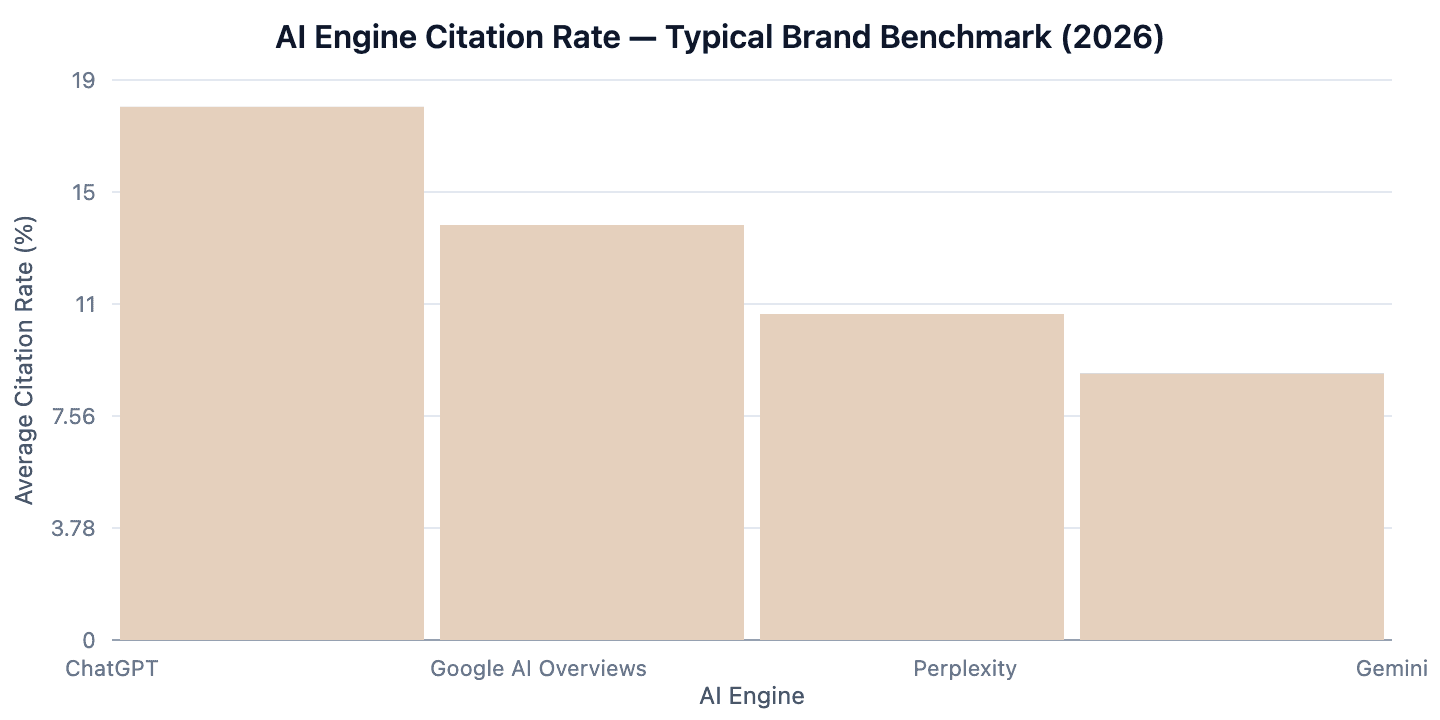
Typical brand citation rates in 2026 are highest on ChatGPT and lowest on Gemini, with Google AI Overviews and Perplexity sitting in between. A mid-market brand running a 50-prompt tracked set across all four engines should expect roughly 18% citation rate on ChatGPT, 14% on Google AI Overviews, 11% on Perplexity, and 9% on Gemini. Use these as a baseline: if your numbers sit meaningfully below them on any single engine, that engine is your highest-leverage optimisation target.
AI Engine | Typical Citation Rate (2026) | Relative Rank |
|---|---|---|
ChatGPT | 18% | 1 (highest) |
Google AI Overviews | 14% | 2 |
Perplexity | 11% | 3 |
Gemini | 9% | 4 (lowest) |
Source: Videntic 2026 brand benchmark, based on tracked-prompt citation data across ChatGPT, Google AI Overviews, Perplexity, and Gemini. Citation rate is defined as the share of tracked prompts in which a brand is named in the AI engine's generated answer.
Frequently Asked Questions
How is AI visibility measured?
AI visibility is measured by running a set of tracked prompts across AI engines (ChatGPT, Perplexity, Gemini, Google AI Overviews) and recording whether your brand is cited in each response. The core metric is citation rate — the share of prompts where your brand appears. Share of voice adds the competitive dimension: your citations as a percentage of all citations across tracked brands for the same prompt set.
How many prompts do I need to track?
Start with 20–50 prompts covering your core product categories, key how-to questions, and the competitor-gap queries where rivals are already cited. At this scale the citation rate is statistically meaningful and the tracking cadence is manageable. Expand to 100+ prompts once you've established a baseline and identified which clusters drive the most citation opportunity for your brand.
How often should I check my AI visibility?
Weekly is the minimum cadence for a meaningful trend signal. AI engine behaviour shifts with model updates and new competitor content; monthly checks miss short-term drops and make it hard to attribute gains to specific actions. Automated tracking tools like Videntic run continuously so you always have a current snapshot without manual effort.
Is AI visibility the same as Google AI Overview visibility?
No — Google AI Overviews is one channel within AI visibility. Full AI visibility tracking covers ChatGPT, Perplexity, Gemini, and Google AI Overviews as separate engines, each with its own citation patterns and source preferences. A brand can rank well in Google AI Overviews but have near-zero Perplexity citations, missing a growing share of AI-driven search traffic.
Can I track AI visibility manually without a tool?
Manual tracking is feasible for 10–20 prompts across one or two engines, but it breaks down at scale. Tracking 50+ prompts weekly across four engines, recording position data, and computing SOV by competitor requires automation. Manual tracking also introduces inconsistency — AI responses vary by session, account, and geography, so systematic prompt firing and response parsing is needed for reliable data.
What's the fastest way to improve my AI visibility?
The fastest path is to identify the prompts where competitors are cited and you are not — your content gaps — and publish structured, authoritative content that directly answers those queries. Pair that with GEO technical fixes: structured data (schema markup), clear heading hierarchies, and self-contained paragraphs that AI engines can extract and cite verbatim. Videntic's content gap report and GEO audit surface both layers in one workflow, so you can prioritise the fixes most likely to move your citation rate quickly.